


Why Dew Point Readings on Refrigerated Dryers Can Be Misleading — And What Plants Must Monitor Instead

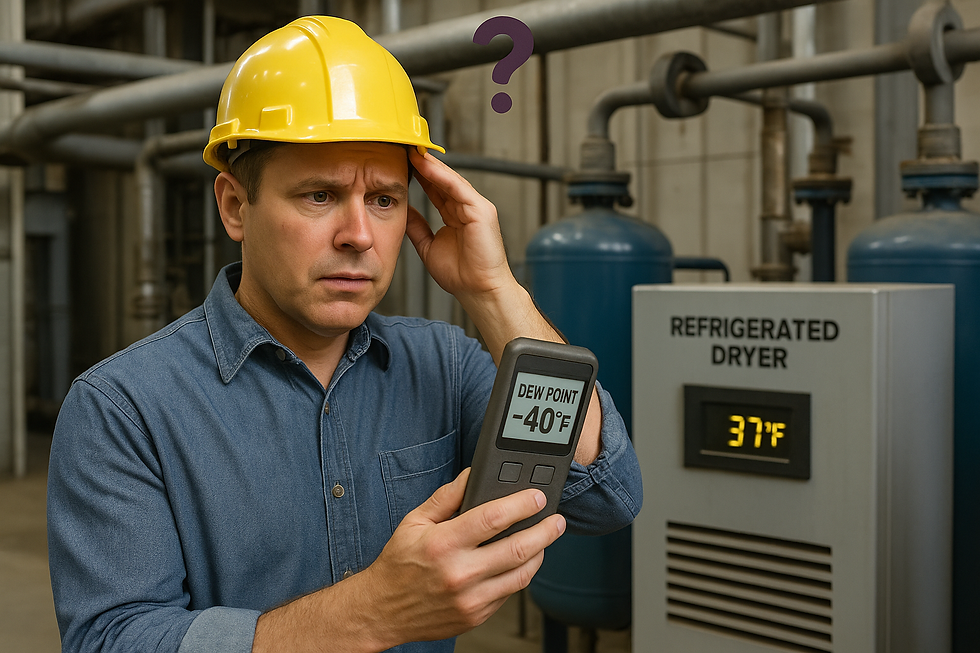
Compressed air users rely heavily on refrigerated dryers to protect their equipment and processes from moisture. Almost every dryer today displays a “dew point” on its front panel, and operators often assume this number represents the true dryness of the air delivered to the plant.
However, in most refrigerated dryers, the displayed “dew point” is not a true measurement of moisture content. Instead, it is usually just the evaporator temperature, the coldest point inside the dryer. Under ideal conditions, evaporator temperature and actual pressure dew point (PDP) may align — but real industrial systems rarely operate in perfect conditions.
This gap between displayed dew point and actual dew point is the source of many hidden air-quality issues, including corrosion, water carryover, instrument freeze-ups, and failed ISO 8573-1 compliance audits.
This article explains why refrigerated dryer dew point displays can be misleading, what actually determines air quality, and how facilities can ensure they know the true dew point of their compressed air.
How Refrigerated Dryers Produce Dry Air
A refrigerated dryer works by chilling compressed air to about 2–7°C, forcing water vapor to condense. The process includes:
Precooling in an air-to-air heat exchanger
Deep cooling in the evaporator coil
Moisture separation and drainage
Reheating the dry air to stabilize outlet temperature
The refrigeration cycle behind this process consists of compression, condensation, expansion, and evaporation — maintaining the cold conditions needed for moisture removal.
The working principle is straightforward:cool the air → remove moisture → deliver dry air.
But the complexity lies in how we monitor and verify dryness.

Credit - TOPRING
What the Dryer Displays — and What It Actually Means
Most refrigerated dryers do not contain a dew point sensor. Instead, they measure the evaporator temperature, which is used to:
Control refrigeration load
Prevent icing
Indicate performance
Display a “dew point” on the panel
A key assumption is made:If the air is saturated at the coldest temperature in the dryer, then that temperature equals its dew point.
This assumption only holds if:
Air fully reaches saturation at the evaporator
The evaporator cooling is uniform
Moisture separation is complete
Drainage is functioning properly
Flow conditions are stable
When any of these conditions drift, the dryer’s displayed value no longer reflects the actual dew point.
Why Displayed Dew Point Becomes Misleading

There are several real-world conditions under which a refrigerated dryer display becomes unreliable.
1. Drain Failure or Incomplete Moisture Removal
A blocked drain or malfunctioning separator allows liquid water to remain inside the dryer.The evaporator still reads “3°C,” but the plant receives air far wetter than expected.
This is one of the most common causes of water complaints despite a “good” dew point reading.
2. Partial Load Conditions
Under low-flow or intermittent use:
The evaporator becomes too cold
Air does not remain long enough at saturation temperature
Moisture removal becomes inconsistent
The displayed evaporator temperature may look perfect, but the actual dew point rises.
3. Overloading or Undersized Dryer
If flow exceeds the dryer’s rating, the air cannot be cooled sufficiently.
A dryer designed for +3°C PDP may deliver +10°C or +15°C under overload — yet many operators do not recognize that a slightly higher displayed number indicates a serious moisture risk.
4. Fouled Heat Exchangers or Refrigeration Issues
Dirt, oil vapor, or insufficient refrigerant reduces cooling efficiency.A sensor on a single cold spot does not detect uneven cooling or bypassing inside the heat exchanger.
The result:the dryer looks healthy internally while air leaving the dryer is not fully dry.
5. Mixing of Wet and Dry Air
If a bypass valve leaks or lines are misconfigured, untreated air can mix with dried air downstream.
The dryer display continues to show an ideal value — but the plant experiences water issues.
6. Environmental Mismatch
Even a true +3°C dew point is only suitable for indoor environments above that temperature.If piping runs outdoors or through cold areas, air can cool below its PDP and water will condense regardless of what the dryer display shows.
This is often misunderstood, resulting in surprising water problems during seasonal changes.
Why Actual Dew Point Matters
The true Pressure Dew Point determines:
Whether condensation will occur in the distribution system
Whether pneumatic instruments remain reliable
Whether ISO 8573-1 purity classes are met
Whether moisture-sensitive processes remain protected
A refrigerated dryer display is not a reliable measure for any of these requirements.
How Plants Can Ensure They Know Their Actual Dew Point
1. Install a Dedicated Dew Point Sensor
A calibrated PDP transmitter downstream of the dryer provides a true, continuous measurement of delivered air quality.
2. Trend and Alarm Dew Point Values
A gradual rise in dew point often indicates:
Refrigeration inefficiency
Fouled heat exchangers
Drain problems
Overloaded dryer conditions
Alarms help prevent water issues before they disrupt production.
3. Maintain Drains and Filters
Many apparent “dew point problems” originate from blocked drains or saturated filters — not refrigeration failure.
4. Match Dryer Type to Requirements
Refrigerated dryers are suitable for general industrial use but not for:
Low temperature environments
Processes requiring PDP below 0°C
Precision moisture-sensitive applications
Desiccant technology is required for low dew point classes.
5. Verify Instrument Accuracy
Periodic calibration ensures moisture sensors and dryer displays remain reliable.
Conclusion
Refrigerated air dryers play a crucial role in industrial compressed air systems, but the dew point displayed on their panels is not a true measure of dryness. It is typically an internal temperature measurement that can diverge significantly from the actual dew point under real-world operating conditions.
To ensure reliable air quality, plants must measure the actual Pressure Dew Point downstream of the dryer, maintain drainage systems properly, and understand the limitations of refrigerated dryer technology.
By replacing assumptions with accurate measurement, facilities can prevent moisture-related failures, improve reliability, and maintain compliance with air quality standards. To Know more on how you can improve your dewpoint contact our specialists today at +91-9843145445 or write to us at support@systel.asia.


Comments